Ore
Ore is natural rock or sediment that contains one or more valuable minerals, typically containing metals, that can be mined, treated and sold at a profit. Ore is extracted from the earth through mining and treated or refined, often via smelting, to extract the valuable metals or minerals. The grade of ore refers to the concentration of the desired material it contains. The value of the metals or minerals a rock contains must be weighed against the cost of extraction to determine whether it is of sufficiently high grade to be worth mining, and is therefore considered an ore.
Minerals of interest are generally oxides, sulfides, silicates, or native metals such as copper or gold. Ores must be processed to extract the elements of interest from the waste rock. Ore bodies are formed by a variety of geological processes generally referred to as ore genesis.
Ore deposits
An ore deposit is an economically significant accumulation of minerals within a host rock. This is distinct from a mineral resource as defined by the mineral resource classification criteria. An ore deposit is one occurrence of a particular ore type. Most ore deposits are named according to their location (for example, the Witwatersrand, South Africa), or after a discoverer (e.g. the Kambalda nickel shoots are named after drillers), or after some whimsy, a historical figure, a prominent person, something from mythology (phoenix, kraken, serepentleopard, etc.) or the code name of the resource company which found it (e.g. MKD-5 was the in-house name for the Mount Keith nickel sulphide deposit).
Classification
Hydrothermal epigenetic deposits
Granite related hydrothermal
Magmatic deposits
Volcanic-related deposits
Metamorphically reworked deposits
Carbonatite-alkaline igneous related
Sedimentary deposits
Hydrothermal deposits formed largely from basinal brines
Astrobleme-related ores
Hydrothermal epigenetic deposits
- Mesothermal lode gold deposits, typified by the Golden Mile, Kalgoorlie.
- Archaean conglomerate hosted gold-uranium deposits, typified by Elliot Lake, Ontario, Canada and Witwatersrand, South Africa.
- Epithermal stockwork vein deposits.
- IOCG or iron oxide copper gold deposits, typified by the supergiant Olympic Dam Cu-Au-U deposit.
- Porphyry copper +/- gold +/- molybdenum +/- silver deposits.
- Intrusive-related copper-gold +/- (tin-tungsten), typified by the Tombstone, Arizona deposits.
- Hydromagmatic magnetite iron ore deposits and skarns.
- Skarn ore deposits of copper, lead, zinc, tungsten, etcetera.
Magmatic deposits
- Magmatic nickel-copper-iron-PGE deposits including
- Cumulate vanadiferous or platinum-bearing magnetite or chromite
- Cumulate hard-rock titanium (ilmenite) deposits
- Subvolcanic feeder subtype, typified by Noril'sk-Talnakh and the Thompson Belt, Canada
- Intrusive-related Ni-Cu-PGE, typified by Voisey's Bay, Canada and Jinchuan, China
- Lateritic nickel ore deposits, examples include Goro and Acoje, (Philippines) and Ravensthorpe, Western Australia.

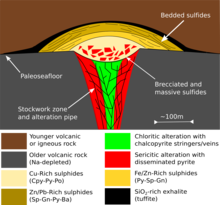
- Volcanic hosted massive sulfide (VHMS) Cu–Pb–Zn.
- Examples include Teutonic Bore and Golden Grove, Western Australia.
- Besshi type.
- Kuroko type.
Metamorphically reworked deposits
- Podiform serpentinite-hosted paramagmatic iron oxide-chromite deposits, typified by Savage River, Tasmania iron ore, Coobina chromite deposit
- Broken Hill Type Pb–Zn–Ag, considered to be a class of reworked SEDEX deposits
- Phosphorus-tantalite-vermiculite (Phalaborwa South Africa).
- Diatreme hosted diamond in kimberlite, lamproite or lamprophyre.
Sedimentary deposits

- Banded iron formation iron ore deposits.
- Channel-iron deposits or pisolite type iron ore.
- Heavy mineral sands ore deposits and other sand dune hosted deposits.
- Alluvial gold, diamond, tin, platinum or black sand deposits.
- Alluvial oxide zinc deposit type: sole example Skorpion Zinc.
Hydrothermal deposits formed by basinal saline fluids, include the following main groups:



No comments:
Post a Comment